

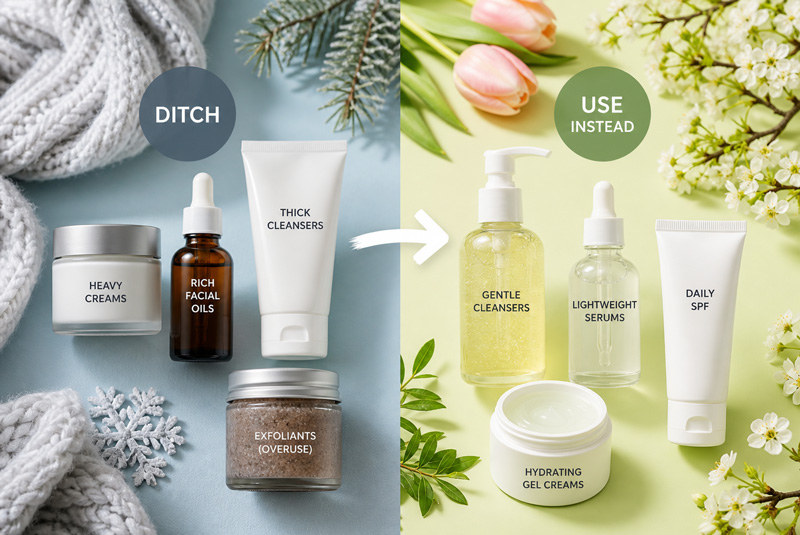

Spring Skincare Swap: Which Winter Products to Ditch (and What to Use Instead)
Table of Contents
Introduction
After months of relying on rich moisturizers, thick balms, and barrier-repair creams, spring is the season when many of those winter staples can start working against your skin instead of for it.
As temperatures rise and humidity increases, your skin’s needs begin to shift. Products that helped protect against winter dryness can suddenly feel too heavy, leading to clogged pores, excess shine, and a less balanced complexion. Hot environments are associated with increased sebum secretion and greasiness, reinforcing the need to reassess your routine as the weather shifts. The American Academy of Dermatology explains that seasonal changes can affect skin hydration, oil production, and overall sensitivity, which is why adjusting your routine in spring is so important.
Winter skincare is usually centered on intense moisture and protection. In spring, however, skin often benefits from lighter, more breathable spring skincare products that support hydration without overwhelming the skin. Making the right swaps can help maintain a healthy skin barrier while also reducing congestion and seasonal flare-ups.
In this article, we will review which winter products to ditch, what to replace them with, and how to transition to smarter spring skincare products for healthier-looking skin. For personalized skincare guidance and expert treatment recommendations, visit Bryn Mawr Dermatology and explore their services. Call us to book your appointment.
While this article spells out some important information about Spring Skincare, we highly recommend you read the full article, here are the key points we will focus on:
Why Does Your Skin Actually Need Different Products In Spring?
As temperatures rise, your skin doesn’t just feel different; it functions differently, which is why adjusting to the right spring skincare products is essential.
Seasonal changes have a measurable impact on the skin. Summer is the highest sebum-secreting season, with seasonal variations confirmed across facial zones. Humid conditions with increased sebum production can lead to oilier skin and a higher risk of clogged pores.
From a physiological standpoint, winter skincare is designed to compensate for a compromised skin barrier. Cold air, wind, and indoor heating strip moisture, requiring thicker, occlusive products to lock hydration in. In spring, however, increased ambient humidity means your skin retains moisture more effectively on its own. This reduces the need for heavy occlusion, while rising temperatures stimulate sebaceous gland activity, resulting in more oil production.
The result? Continuing with winter products can overwhelm the skin, leading to congestion, breakouts, and imbalance. Transitioning to lighter, breathable spring skincare products helps align your routine with your skin’s natural seasonal behavior, supporting barrier function without overloading it.
Should You Ditch Your Heavy Winter Moisturizer?
As your skin adapts to warmer, more humid conditions, one of the first products to reassess is your moisturizer. The rich formulas that protected your skin in winter may now be too heavy for spring.
When should you consider switching your moisturizer?
- Your skin feels greasy or looks shinier by midday
- You’re noticing more clogged pores or breakouts
- Your moisturizer feels heavy or sits on top of the skin
- Makeup isn’t blending well or is sliding off
- The weather has become consistently warmer and more humid
In winter, thick creams and ointments are essential to combat dryness and protect a compromised skin barrier. These formulations are designed to create an occlusive layer that locks in moisture and shields the skin from harsh environmental conditions. However, as spring arrives, your skin naturally retains hydration more efficiently due to increased humidity and reduced environmental stress.
Continuing to use heavy moisturizers during this time can lead to congestion and imbalance, particularly for those prone to acne or combination skin. Instead, opt for lighter spring skincare products such as gel-creams or fluid-based moisturizers that provide hydration without clogging pores. If you’re unsure which formulation is best for your skin type, the team at Bryn Mawr Dermatology can help tailor a routine that keeps your skin balanced and healthy. Call us to book your appointment.
Is Your Vitamin C Serum Still Working For You This Spring?
What the Science Says About Vitamin C
- Powerful antioxidant protection: Neutralizes free radicals from UV exposure and pollution
- Boosts collagen production: Helps improve firmness and reduce fine lines over time
- Brightens and evens skin tone: Reduces melanin production and fades dark spots
- Clinically observed improvements: Studies show visible reduction in wrinkles and improved texture after consistent use
- Hyperpigmentation results: Visible fading of dark spots observed in clinical studies with consistent daily use
- Supports UV defense: Helps protect against photoaging and sun-induced damage
Why It Still Matters, Especially in Spring
Vitamin C remains one of the most evidence-backed skincare ingredients, with broad benefits ranging from photoprotection to anti-aging. As a topical antioxidant, it plays a critical role in neutralizing oxidative stress while stimulating collagen synthesis and improving pigmentation irregularities.
However, not all vitamin C serums perform equally. Stability, formulation (especially L-ascorbic acid), and storage conditions significantly impact efficacy. Over time, oxidation can reduce potency, meaning that serum you’ve been using since winter may no longer be as effective.
Spring is actually the perfect time to commit to or upgrade your vitamin C routine. With increased sun exposure and environmental stressors, incorporating a fresh, stable formula can help protect your skin, enhance radiance, and support a smoother, more even complexion heading into the warmer months.
Are You Wearing Enough Sunscreen As The Days Get Longer?
Key factors to consider
- UV exposure increases with daylight duration, not just temperature
- UVA rays remain constant year-round, contributing to aging and pigmentation
- Cloud cover doesn’t block UV radiation, often leading to under-protection
- Incidental exposure (walking, driving, sitting near windows) adds up quickly
- Most people under-apply sunscreen, reducing labeled SPF protection significantly
- Reapplication is often missed, especially during longer outdoor days
- SPF in makeup or moisturizers is usually not enough on its own
Why this matters more as days get longer
This is the big one. Longer daylight hours plus more time outdoors means your baseline exposure quietly increases, even if your routine feels the same. UV damage is cumulative, so those extra 30–60 minutes outside each day can meaningfully accelerate photoaging and increase risk over time.
A “standard” SPF habit that worked in winter often doesn’t hold up in spring and summer. Dermatology guidance consistently emphasizes daily broad-spectrum SPF 30 or higher, with reapplication every two hours during sustained exposure. When days are longer, that reapplication window becomes more important, not less.
In practical terms, this is the moment to reassess not just whether you’re wearing sunscreen, but whether you’re wearing enough, applying it correctly, and reapplying often enough to match your actual time in daylight.
Which Winter Products
Which Winter Products Should You Keep In Your Spring Routine?
What the evidence tells us
- Retinoids remain effective year-round, with consistent use shown to improve fine lines, texture, and acne over time when paired with daily SPF
- Gentle cleansers help preserve the skin barrier, which is especially important as seasonal changes can trigger sensitivity
- Barrier-supporting routines reduce irritation risk, particularly when active ingredients like retinol are in use
- Eye creams with peptides or hydrators can continue supporting thin, delicate skin without seasonal interruption
What stays in your routine (and why)
Not everything needs to go. Gentle cleansers, retinol (with increased SPF protection), and a good eye cream can absolutely stay in your spring routine. These are foundational products that support skin health regardless of season, especially when used consistently.
Retinol, for example, remains one of the most well-studied ingredients for collagen support and skin renewal. The key seasonal adjustment isn’t stopping it, it’s ensuring you’re pairing it with diligent sunscreen use as UV exposure increases. Similarly, gentle cleansers help maintain barrier integrity as weather shifts, preventing the dryness-to-oiliness swing many people experience in spring.
How Do You Transition Your Skincare Routine Gradually Without Irritating Your Skin?
How to transition your routine safely
- Introduce one product at a time to clearly identify how your skin responds
- Patch test new products on a small area before full-face use
- Wait 2–3 weeks before evaluating results, since early irritation or “purging” can be misleading
- Reduce frequency initially for active ingredients (e.g., retinol or acids) before building back up
- Maintain barrier support with hydrating and soothing products during the transition period
- Avoid stacking too many new actives at once, which can overwhelm the skin
How Can Bryn Mawr Dermatology Help You Transition Into Spring?
Bryn Mawr Dermatology provides personalized, medically guided care to help you transition your skincare safely and effectively. Their dermatology team evaluates your skin’s needs and creates tailored treatment plans that support barrier health, optimize active ingredients, and address concerns like acne, pigmentation, or sensitivity.
What sets them apart is their blend of medical expertise and individualized care, ensuring recommendations are based on your skin, not trends or guesswork.
Take the Next Step
If you’re unsure how to adjust your routine this spring, Bryn Mawr Dermatology can guide you with expert, customized care. Schedule a consultation today by calling (610) 525-7800 and get a personalized plan designed for healthier, more balanced skin this season.
Content Review Committee at Bryn Mawr Dermatology
Published By: Bryn Mawr Dermatology
Medically Reviewed By: Christine Stanko, MD, FAAD
Related Content

Is My Skin Red or Do I Have Rosacea? How to Know
One of the most common skin concerns is facial redness, and it is also one of the most misunderstood. Occasional flushing is mostly harmless, but persistent redness may indicate a chronic condition like rosacea.

Don’t Wait for Summer to Think About Skin Cancer
Don’t wait for summer to prioritize your skin health. Book your annual skin check today. Call us to schedule your appointment.

MultiFrax vs. Traditional Fractional Lasers: What Makes It Better?
Discover how multifrax compares to traditional fractional lasers and why it delivers better precision and faster recovery.

Why Winter Is the Ideal Season for Peels, Lasers, and CO₂ Treatments
Winter is the ideal time for peels, lasers, and CO₂ treatments with less sun exposure, smoother recovery, and better skin results.

How to Prevent and Treat Winter Skin Flare-Ups
Learn how to prevent and treat winter skin flare-ups with expert tips on hydration, skincare routines, and in-office treatments.

Why Healthy Skin Month Is the Perfect Time to Refresh Your Routine
Healthy Skin Month is here! Discover how to protect your skin this winter and book your skincare consultation today!
Content Review Committee at Bryn Mawr Dermatology
By: Bryn Mawr Dermatology, Published: June 25, 2024
Medically Reviewed By: Christine Stanko, MD, FAAD – June 25, 2024